
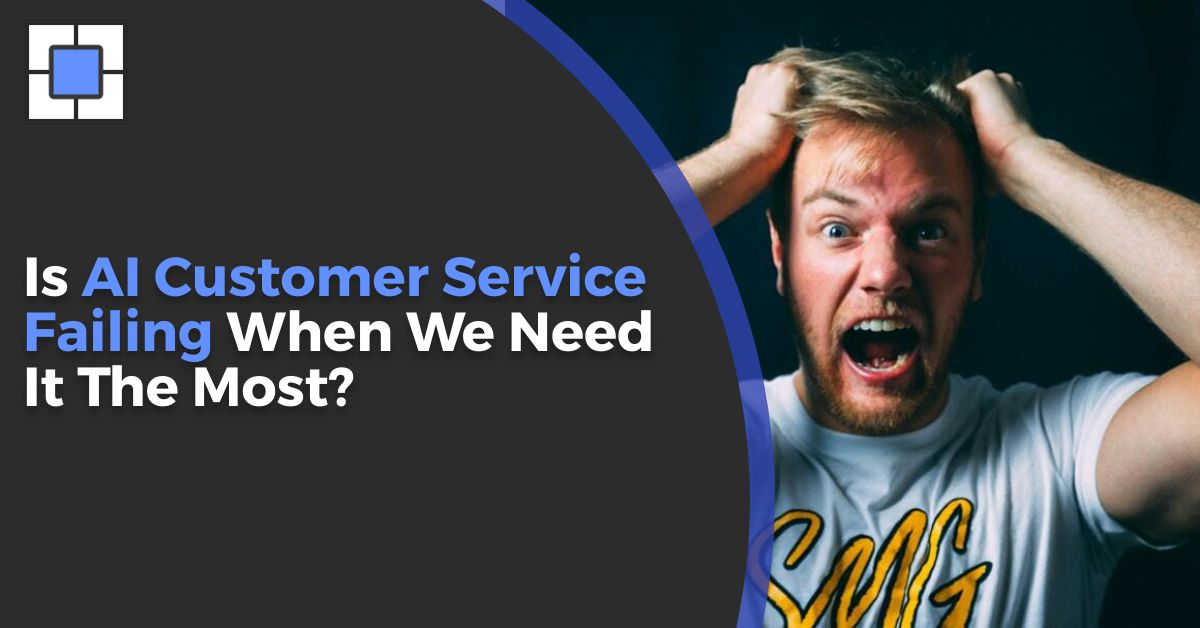
I needed to check in for my father’s flight. The airline’s AI chatbot asked for information we didn’t have. No problem, I thought. I’ll just ask for help.
But there was no help to be found.
The AI couldn’t adjust. It couldn’t connect me to a human. It just kept cycling through the same useless suggestions while our frustration mounted.
This isn’t rare. It’s becoming the norm.
Companies are rushing to implement AI in customer service, but many are getting it fundamentally wrong. They’re creating systems that work beautifully for general information but trap customers in endless loops when dealing with specific account issues or complex problems.
The results are predictable. According to research, when customers encounter barriers to human escalation, 50-90% simply give up on their inquiry. For those who struggle to escalate, the damage to the customer relationship is typically double compared to when they abandon the interaction entirely. (https://customerthink.com/how-to-implement-disaster-free-ai-in-service-ease-of-escalation-is-the-key/)
It just makes you angry. Frustrated.
Nearly a third of customers report swearing at customer support robots due to frustration. (https://www.cmswire.com/customer-experience/overcoming-customer-frustration-with-advanced-ai/)
I’ve seen this especially with chat widgets. The human expects almost instant help, but the AI goes in circles. Sometimes you just want to jump on a call and chat with someone who can actually solve your problem.
Why Companies Get AI Wrong
What’s driving this rush to over-automate? Several factors are at play.
Some companies want to be first. They want in on the AI dream.
Cost-cutting is another major driver. If AI can handle work humans don’t want to do and do it faster and more efficiently, the financial case seems clear.
There’s also an experimental aspect. Companies are gathering data to gain deeper insights that might improve service in the future.
But in this rush, many miss a critical insight: task complexity matters enormously in customer satisfaction.
Research shows that for low-complexity tasks, consumers rate AI problem-solving ability higher than human service. However, for high-complexity tasks, the opposite is true. Humans are viewed as superior and customers are more likely to seek human support. (https://www.sciencedirect.com/science/article/pii/S1441358220300240)
Companies that fail to design their systems with this boundary condition in mind create frustrating experiences.
The Right Way to Implement AI
If I were consulting for a company implementing AI in customer service, I’d start with clear criteria for what AI should handle versus what requires human intervention.
Repetitive tasks are perfect for AI. Initial greetings on calls. Conversational chat. General Q&A. FAQs. Booking appointments.
As AI becomes more integrated, it can handle account lookups with proper verification.
But specific problems and issues requiring manual intervention need human handling. The AI should have a pass-over role too. If it knows it can’t help, it should connect you to a live agent.
I’ve only seen one good implementation. A software company where you start with the bot, but if you’re not getting what you need, you can simply type “agent” and it passes you on immediately.
That simple escape hatch makes all the difference.
Measuring What Matters
Beyond implementation, companies need better measurement.
With our CRM system, when a user calls in, AI answers the call. The call is recorded so we can see what worked and what didn’t through transcription.
We quickly adapt the prompts to address issues that come up, creating a better flow for next time.
This feedback loop is essential. AI should recognize its own boundaries.
If it’s trained on general, public data, that’s fine. But when information is specific to an account that the AI can’t access, it should recognize this limitation and pass the customer to a human.
Transparency about limitations builds trust rather than destroying it.
The Future of AI Customer Service
We’re in a transition time. AI is getting better rapidly.
We’ve recorded conversations where potential clients don’t realize they’re chatting with AI because it’s that good. The technology will only improve.
People will adapt. The human connection matters more to us now because it’s what we’re used to. We complain, as humans do at every chance.
In the future, AI will become more integrated, able to make changes to your data live as it interacts with you.
The real challenge may come with who controls the AI. The intent and ethical considerations of the companies who create and integrate these systems matter enormously.
Data won’t lie unless it’s manipulated.
Companies that say they’re using AI but also offer human support make the technology more appealing. As we all end up with personal AI assistants, this will become normal.
But if AI can’t do something, frustration will still occur. We won’t always know what these issues are until they happen.
Both humans and machines are adapting and learning as we grow together.
The companies that succeed will be those that understand AI’s strengths and limitations. They’ll create systems that know when to step aside and let humans take over.
And most importantly, they’ll never leave a customer trapped in an endless loop with nowhere to turn.

Digital Business Coach | Web Revenue Strategist | Award-Winning IT Consultant | Author | Get 1:1 Step-By-Step and Strategic Guidance.
With over 20 years of industry experience in business and personal development, I’ve successfully been working with coaches, consultants and authors set up the right systems and implement strategic content strategies to start, grow or scale their business online with 1:1 services and online courses.
I can help you or your small business cut through the noise and map out the most efficient path from point A to Point B and Guide you on How To Transform Your Skills And Knowledge Into A Structured And Automated Coaching, Consulting or Author Business Without Tech Overwhelm, Noise or Distractions Online. Schedule a Call